



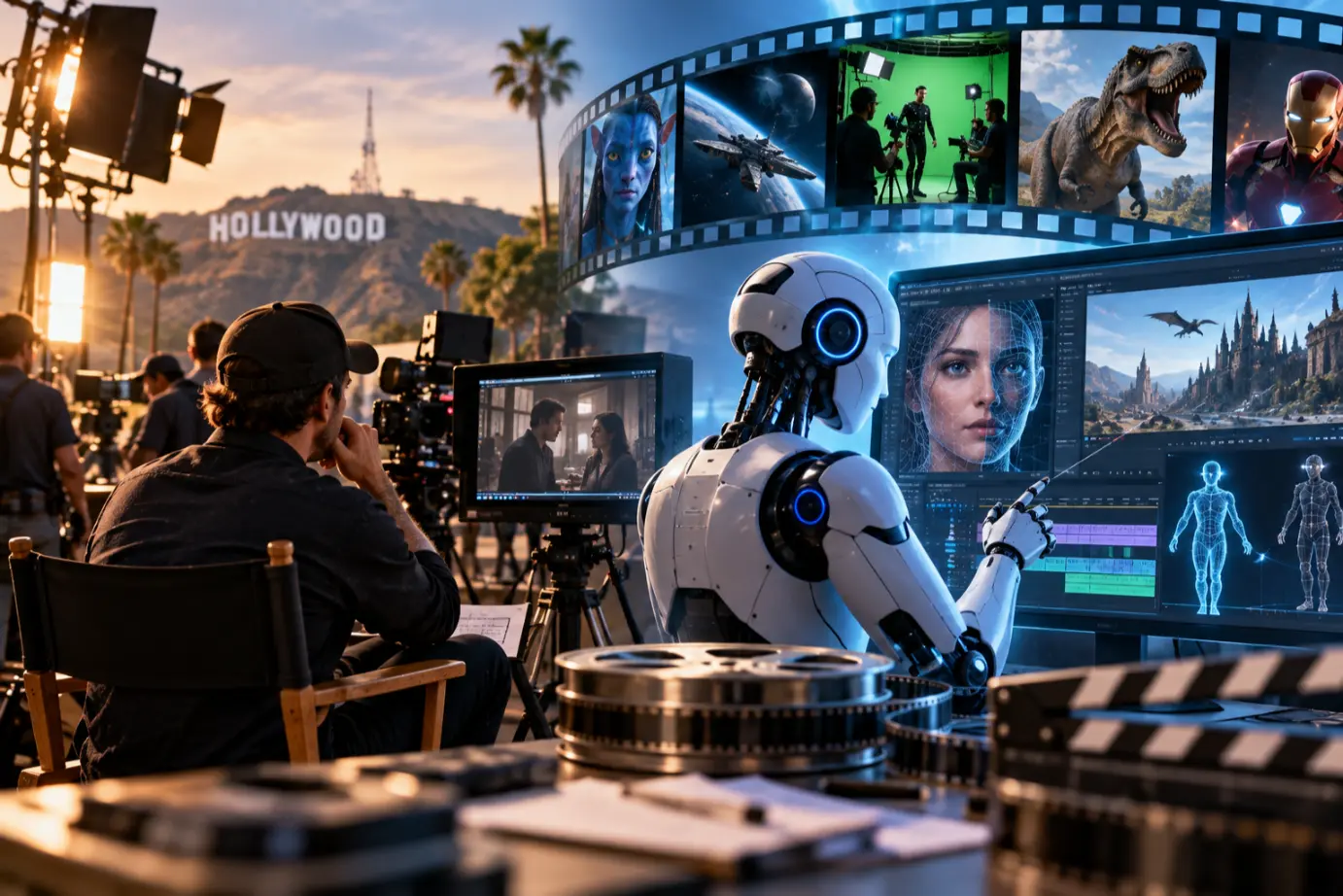
Hollywood is entering a new phase as artificial intelligence begins to influence almost every part of filmmaking from writing and visual effects to post-production, digital performers and even the way films are marketed. While studios see AI as a tool that can save time and reduce costs, actors, writers and other creatives remain concerned about jobs, copyright and the future of human storytelling.
Artificial intelligence is no longer limited to experimental projects in Hollywood. The technology is increasingly being used behind the scenes, quietly becoming part of the filmmaking process.
So, how exactly is AI changing Hollywood? Here is a simple explainer.
Where Is AI Being Used In Hollywood?
AI can now assist filmmakers at several stages of production.
During the development stage, AI tools can help with tasks such as analysing scripts, generating ideas, creating storyboards and visualising scenes.
In production and post-production, AI can assist with visual effects, background creation, editing, dubbing and other technical processes.
The technology can also generate or modify images and video, allowing filmmakers to create elements that could otherwise require large teams, expensive sets or lengthy production schedules.
Recent AI-powered film projects have demonstrated how quickly these tools are developing. Some new studios are experimenting with technology that can generate backgrounds, visual effects and even synthetic performers.
Why Are Hollywood Studios Interested In AI?
The biggest attraction is time and cost.
Film production can involve hundreds of people, expensive locations, elaborate sets and months of post-production work. AI tools could reduce the time required for some of these tasks.
For studios, this could mean lower production costs and faster workflows.
AI could also make certain types of films easier to produce, particularly projects that require extensive visual effects or large numbers of digital environments.
The technology is therefore being viewed by some filmmakers as another filmmaking tool, rather than simply a replacement for traditional production methods.
Can AI Replace Actors?
This remains one of the most controversial questions.
AI can create digital versions of human faces and voices, raising the possibility of using synthetic performances in films.
However, many actors and filmmakers argue that technology cannot fully reproduce the emotional depth and human experience that actors bring to a performance.
Actor Brad Pitt, for example, has said AI could help make mid-budget films more viable but has expressed scepticism about AI replacing actors.
The debate is therefore not simply about whether AI can technically recreate a performance, but whether audiences and filmmakers will accept that performance as a substitute for a human actor.
What About Writers And Artists?
Writers, visual artists and other creative professionals face similar concerns.
AI-generated content can potentially speed up tasks traditionally handled by humans, but it also raises questions about whether workers could lose jobs or see their roles reduced.
Another major issue is copyright.
AI systems are trained using enormous amounts of data, creating ongoing disputes over whether copyrighted creative work can be used to train such systems without permission.
Hollywood is therefore dealing with two competing ideas: AI could make filmmaking more efficient, but its uncontrolled use could threaten the livelihoods and rights of the people who create films.
Why Are AI Rules Important?
The rapid growth of AI has made rules around digital replicas, consent, copyright and compensation increasingly important.
Actors want control over how their faces and voices are used, while writers and artists want protection for their work.
Industry unions have pushed for safeguards to ensure that AI is used with the consent of performers and does not simply replace human workers.
These questions are likely to become even more important as AI-generated video becomes more realistic.
Is AI The Future Of Hollywood?
AI is already becoming part of Hollywood, but it is unlikely to mean that traditional filmmaking disappears overnight.
Instead, the industry appears to be moving towards a hybrid model in which filmmakers use AI for selected tasks while humans continue to control storytelling, direction, acting and creative decisions.
The real debate is therefore not whether Hollywood will use AI that shift has already begun.
The bigger question is how much AI Hollywood will use, who controls it, and whether the technology will support human creativity or replace parts of it.