



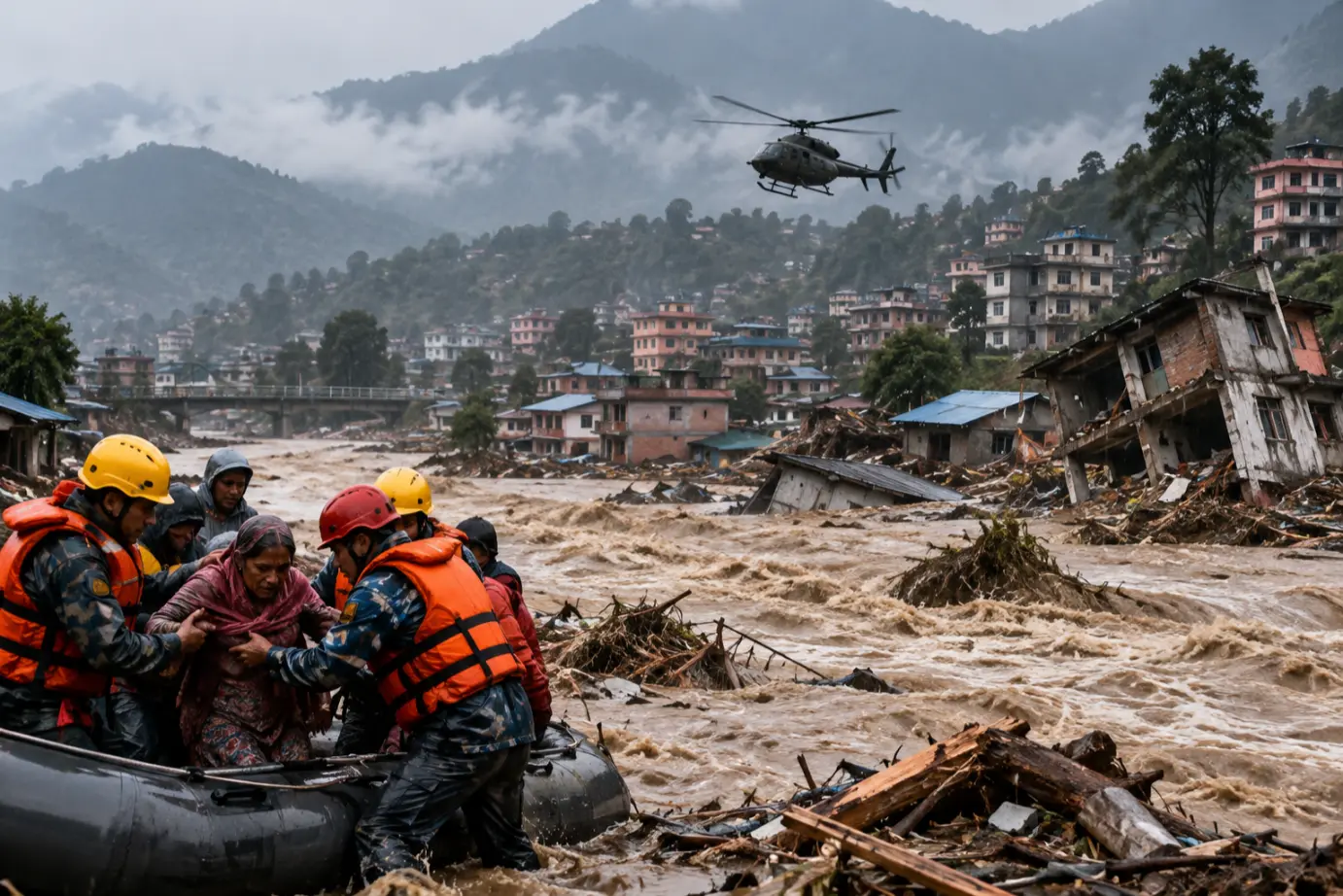
Rescuers use explosives and pump air into submerged tunnels as families cling to hope of finding their loved ones alive
Kathmandu: The search for hundreds of workers feared trapped inside mud-filled hydropower tunnels in Nepal has entered a critical phase, as rescue teams race against time following devastating floods that have killed more than 1,000 people and left thousands missing.
The disaster struck on August 26, when catastrophic flooding and landslides swept through parts of Nepal near the Tibet border. The destruction has been particularly severe along the Trishuli River, where several hydropower projects were damaged and workers were caught underground.
According to Nepalese authorities, more than 600 workers are believed to be trapped inside a network of tunnels at hydropower sites. Families are anxiously waiting for any sign that their relatives may have survived the disaster.
Rescuers Blast Through Hillsides To Reach Workers
The rescue operation has become a race against time.
Teams have been using explosives to break through hillsides and create access points to the buried tunnels. Engineers are also pumping air into the underground passages in the hope that survivors could still be alive inside.
A rescue team managed to enter one tunnel leading towards a hydropower plant but had to withdraw after finding no workers.
The difficult terrain, enormous quantities of mud and debris and damage to access routes have made the operation extremely challenging.
Prime Minister Balendra Shah said hundreds of people had already been rescued from hydropower sites, while international teams continue to support the operation. Chinese and Nepalese military personnel are leading the rescue effort, with experts from India, South Korea and Australia also involved.
Families Refuse To Give Up Hope
For families waiting outside the damaged projects, every passing hour brings both fear and hope.
Anushila Bhandari, whose husband Aurus Bhandari, a 33-year-old engineer, is among those missing, told BBC Nepali that she simply wishes he could return home.
Other relatives have pointed to the presence of oxygen systems inside some of the tunnels as a reason to believe that trapped workers may still be alive.
But rescuers face an increasingly narrow window to reach anyone who survived the initial flooding.
Nepal’s Hydropower Sector Devastated
The floods have also delivered a major blow to Nepal’s hydropower industry, a crucial part of the country’s economy and energy ambitions.
Authorities say at least 11 hydropower projects, either operational or under construction, were damaged by the floods. The destruction of roads, bridges and other infrastructure has further complicated rescue and recovery operations.
The disaster has also raised fresh concerns about the growing risks faced by infrastructure built along Himalayan river systems.
Death Toll Crosses 1,000
The human toll continues to rise. Nepal’s disaster authorities have reported more than 1,000 deaths, while thousands of people remain missing. Bodies have been carried downstream by the powerful river systems, with authorities struggling to identify many of the victims.
In neighbouring Tibet, Chinese authorities have also reported deaths and hundreds of missing people following the disaster.
The scale of the catastrophe has renewed concerns about the vulnerability of the Himalayan region to extreme weather, landslides and glacial-related hazards.
For the families waiting outside the tunnels, however, the immediate priority remains simple: finding their loved ones.
As rescuers continue cutting through mountains and pumping air underground, the desperate search is becoming a race against time and every passing hour matters.