



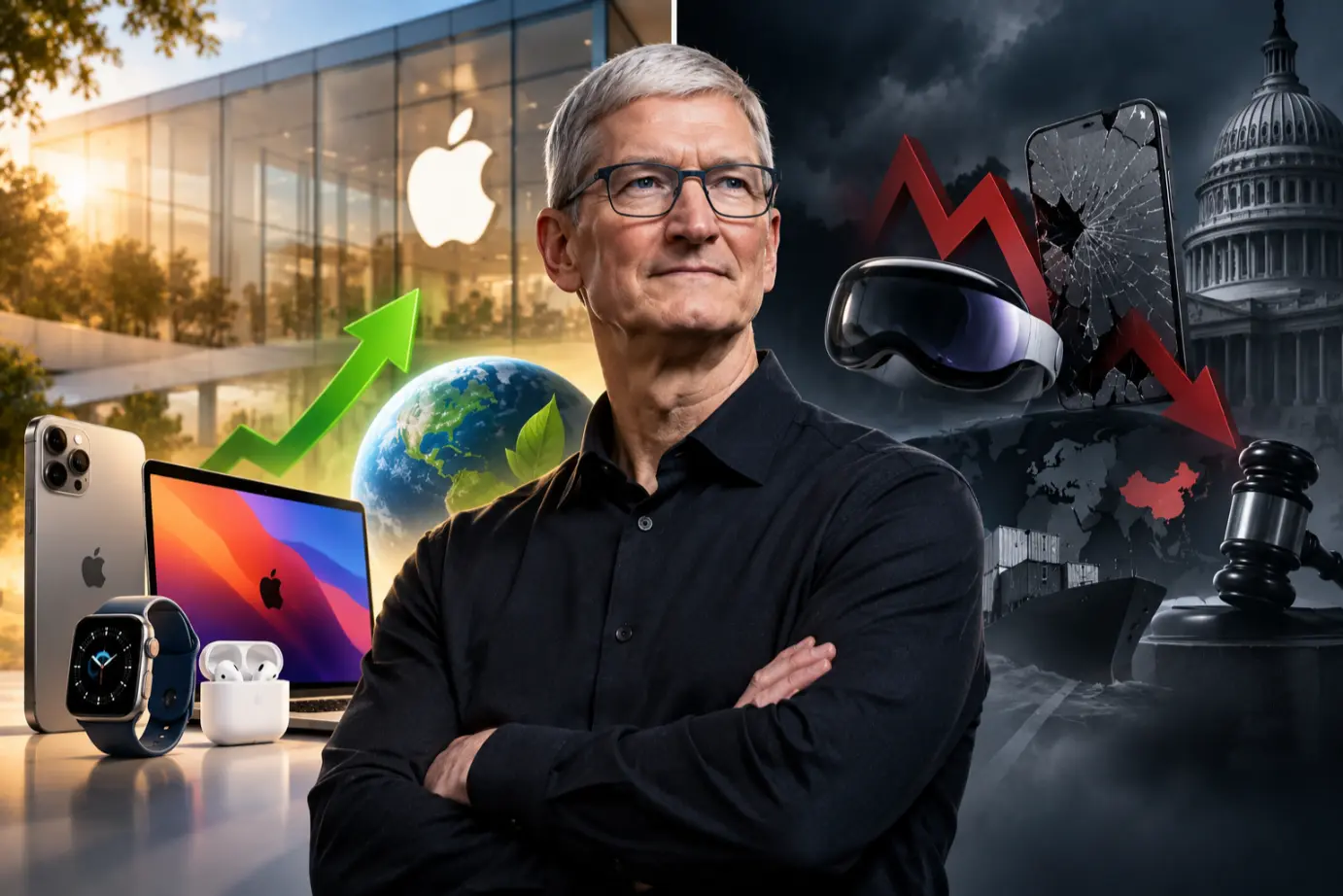
Tim Cook’s Apple Exit
Tim Cook is set to step down as Apple CEO on September 1, ending nearly 15 years at the helm of the technology giant. Cook took charge of Apple in August 2011 after Steve Jobs stepped down because of his deteriorating health.
From $350 Billion To $4 Trillion
When Cook became CEO, Apple was valued at around $350 billion. Under his leadership, the company’s market value grew to around $4 trillion, marking one of the biggest periods of wealth creation in the history of the technology industry.
Apple Revenue Quadruples
Apple’s annual revenue also increased sharply during Cook’s tenure. The company’s revenue rose from around $108 billion in 2011 to more than $400 billion, driven by steady iPhone demand, growth in services and expansion across global markets.
Win 1: Apple’s Services Business
One of Tim Cook’s biggest achievements was reducing Apple’s dependence on hardware by expanding its services business. Products and platforms such as the App Store, Apple Pay and Apple Music became increasingly important to the company’s growth.
Services Cross $100 Billion
Apple’s services business now generates more than $100 billion annually and has higher margins compared with hardware, giving the company an important source of recurring revenue. The services push also helped Apple build a larger ecosystem around its devices.
Win 2: Apple Silicon
Another major success under Tim Cook was Apple’s decision to develop its own processors for Mac computers. The move reduced Apple’s dependence on Intel and gave the company greater control over its hardware and software.
Apple Gains Chip Independence
Apple Silicon became an important part of the company’s product strategy. The transition demonstrated Apple’s ability to design key components internally while integrating its processors closely with its operating systems and devices.
Win 3: Apple Watch And AirPods
Tim Cook also oversaw the launch of two important product categories – Apple Watch and AirPods. Apple Watch was launched in 2015 and became a major product focused on health, fitness and daily use.
AirPods Become A Major Business
A year later, Apple introduced AirPods, helping turn wireless earbuds into a mass-market product category. AirPods eventually became a major revenue generator for Apple and strengthened the company’s ecosystem of connected devices.
Miss 1: Apple Maps
Not every product launch during Tim Cook’s tenure delivered the expected results. Apple Maps, launched in 2012, faced heavy criticism after its debut because of problems including inaccurate and incomplete location data.
Maps Launch Hurts Apple’s Reputation
The early problems with Apple Maps became one of the most visible product missteps of the early Cook era. Apple subsequently continued to improve the mapping service, but its initial launch remains one of the challenges associated with Cook’s tenure.
Miss 2: Vision Pro Struggles
Apple’s Vision Pro headset was launched in 2023 as the company’s entry into mixed-reality computing. However, the product has so far seen limited adoption, with its high price considered a major barrier for consumers.
Vision Pro Faces Adoption Challenge
Unlike products such as the Apple Watch and AirPods, Vision Pro has not yet become a mass-market success. Its future remains uncertain as Apple works to establish a stronger presence in the mixed-reality and spatial computing market.
Miss 3: Apple Car Project Cancelled
Apple’s ambitious electric and self-driving car project, known as Project Titan, was another major setback. The company spent years working on the project but eventually abandoned the effort after facing high costs and an unclear path towards a viable product.
Project Titan Ends After Years Of Work
The cancellation highlighted the difficulty of entering the highly competitive automotive industry. Despite Apple’s financial strength and technological expertise, the company could not establish a clear business and product strategy for a self-driving electric vehicle.
AI Becomes Cook’s Biggest Challenge
Another major challenge for Apple as Tim Cook prepares to leave is artificial intelligence. While companies such as Microsoft, Google and OpenAI moved rapidly to integrate AI into consumer and enterprise products, Apple has taken a slower approach.
Apple Takes A Cautious AI Approach
Apple has focused on privacy, software integration and on-device computing as part of its AI strategy. However, the company now faces growing pressure to close the gap with competitors that have moved aggressively into generative AI.
John Ternus Inherits The AI Challenge
Apple’s incoming CEO John Ternus will have to decide how aggressively the company should compete in artificial intelligence. The success or failure of Apple’s approach could become one of the defining issues of the next phase of the company.
Tim Cook Leaves A Changed Apple
Tim Cook’s Apple legacy is defined by both extraordinary financial growth and strategic challenges. He expanded the company’s services business, helped Apple develop its own chips and successfully launched products such as the Apple Watch and AirPods.
A Strong But Complicated Legacy
At the same time, Apple Maps, the cancelled car project and the limited adoption of Vision Pro show that not every bet paid off. Apple’s slower progress in AI has also emerged as a major concern as the technology industry enters a new phase.
Apple’s Next Chapter
As Tim Cook prepares to step down on September 1, Apple enters a new era under John Ternus. Cook leaves behind a company that is far larger and more financially powerful than the one he inherited in 2011.
What Comes Next For Apple
The challenge for the new leadership will be to maintain Apple’s enormous financial strength while finding the next major growth opportunity. AI, new product categories and continued services growth are likely to play a central role in determining whether Apple’s next chapter can match the success of the Tim Cook era.