



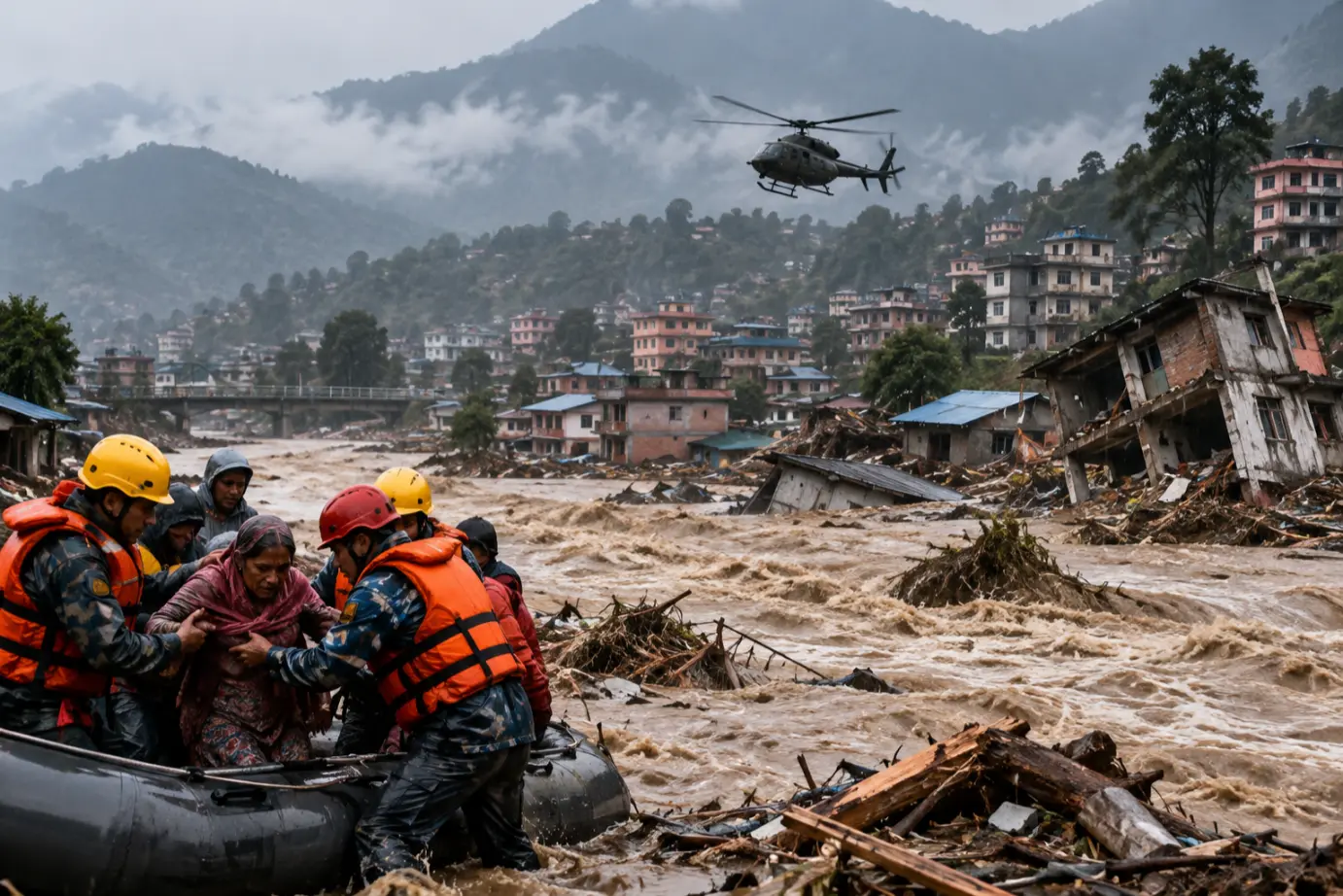
A catastrophic flash flood caused by a massive glacial collapse along the Himalayan border has unleashed widespread destruction across Nepal and neighboring Tibet. The tragedy has claimed at least 584 lives, with nearly 2,500 people reported missing as emergency teams fight hostile terrain, washed-out roads, and secondary flood surges. Officials confirm this is the deadliest natural disaster to strike Nepal since the devastating April 2015 earthquake.
Glacial Collapse and Avalanches Trigger High-Velocity Torrent
The disaster struck on Wednesday when a severe ice-and-rock avalanche collapsed near a high-altitude Himalayan glacier along Tibet’s Gyirong County border. According to analysis by the US Geological Survey and regional disaster authorities, millions of tons of ice, boulders, and sludge surged into local river channels.
The catastrophic flow blocked the Lhende Khola river, generating a massive debris dam. When the natural barrier collapsed, a wall of water swept through the Bhote Koshi and Trishuli river valleys with catastrophic force. Entire settlements, highway networks, critical bridges, and multi-megawatt hydropower installations were buried or swept away within minutes, giving downstream communities virtually no warning to evacuate.
Death Toll Rises as Thousands Remain Unaccounted For Across Borders
The official casualty figures have climbed rapidly as search teams reach previously isolated valleys. Nepal’s National Disaster Risk Reduction and Management Authority (NDRRMA) confirmed that at least 579 people have died within Nepalese territory, while the missing person registry has surged past 1,900.
Across the northern border, Chinese state media reported at least five fatalities in Tibet, with 558 people listed as missing in Gyirong County alone. Combined official data puts the total death toll at 584 and the missing tally at nearly 2,500 across both nations. International agencies, including the International Red Cross, estimate that more than 93,000 residents require urgent humanitarian assistance as food, clean water, and shelter supplies dwindle.
Second Outburst Alert: Debris Dam Spills Over in Tibet
Tension escalated on Friday after fresh alerts were issued regarding secondary hazards upstream. A temporary barrier lake formed by accumulation of mud and ice in Tibet began spilling over, threatening another flash surge along the Bhote Koshi river system.
Nepali police and local administrations issued emergency high-alert warnings, ordering security forces and rescue teams operating along low-lying riverbanks to retreat to safer ground immediately. On the Chinese side, rescue operations were temporarily halted as water levels crested over the debris accumulation. Although state media later reported that the immediate overflow risk had diminished, engineers and disaster officials are continuing aerial monitoring to determine if secondary landslides pose further threats.
Over 14,000 Security Personnel Mobilized in Massive Rescue Drive
In response to the catastrophe, Nepal has deployed more than 14,000 security personnel including specialized units from the Nepal Army, Armed Police Force, and Nepal Police. Armed with heavy machinery, drones, and search dogs, crews are sifting through heavy sludge, collapsed structures, and fallen timber.
Emergency personnel have successfully rescued approximately 3,742 survivors, with military helicopters carrying out aerial evacuations in remote mountain settlements. Search operations remain focused on critical infrastructure zones, including power generation tunnels along the Trishuli River basin where hundreds of workers were trapped when floodwaters sealed tunnel entrances.
320 Indian Nationals Uncontactable as MEA Coordinates Rescues
Addressing a press conference, Ministry of External Affairs (MEA) spokesperson Randhir Jaiswal provided a comprehensive update on rescue efforts involving Indian tourists, pilgrims, and infrastructure workers stranded in the affected valleys.
“In addition to these 21 Indian nationals, yesterday we gave you an update about 63 Indian nationals who are working at the Trishuli One hydropower project. They were also rescued yesterday. In addition to these 21 and 63, we have learned that 96 Indian nationals who were stranded on the Chinese side have safely crossed into Nepal by land,” Jaiswal stated.
The MEA confirmed that approximately 320 Indian nationals and around 100 individuals of Indian origin remain uncontactable. Diplomatic missions in Kathmandu are maintaining constant coordination with local authorities and emergency helplines to track missing citizens and expedite their safe evacuation.